
A home isn’t always the only asset that needs a careful valuation in a divorce. For a divorce property appraisal in Orlando, the fee depends on the property and assignment scope, and is provided after a quote request. Florida uses equitable distribution for marital assets, so a well-supported valuation can help clarify what is being divided.
It’s understandable to focus first on the house, especially when spouses disagree about its value or one wants to keep it. A business, fine art, antiques, jewelry, or luxury vehicles may also require professional appraisal. This article explains what can affect appraisal fees, which assets may need valuation, and how comparable home sales help an appraiser assess a residence. It also covers how an independent report can support discussions about selling a home, a buyout, or dividing other property.
Key Takeaways
- Understand what can shape an appraisal fee, including the property and scope of the assignment.
- Identify which assets beyond a home may need a professional valuation during a divorce.
- See how comparable local sales and property differences inform an independent home value.
- Learn what to look for in an appraiser, including impartiality and courtroom experience.
- Use a clear valuation report to support discussions about a home sale, a buyout, or dividing assets.
How Much Does a Divorce Appraisal Cost?
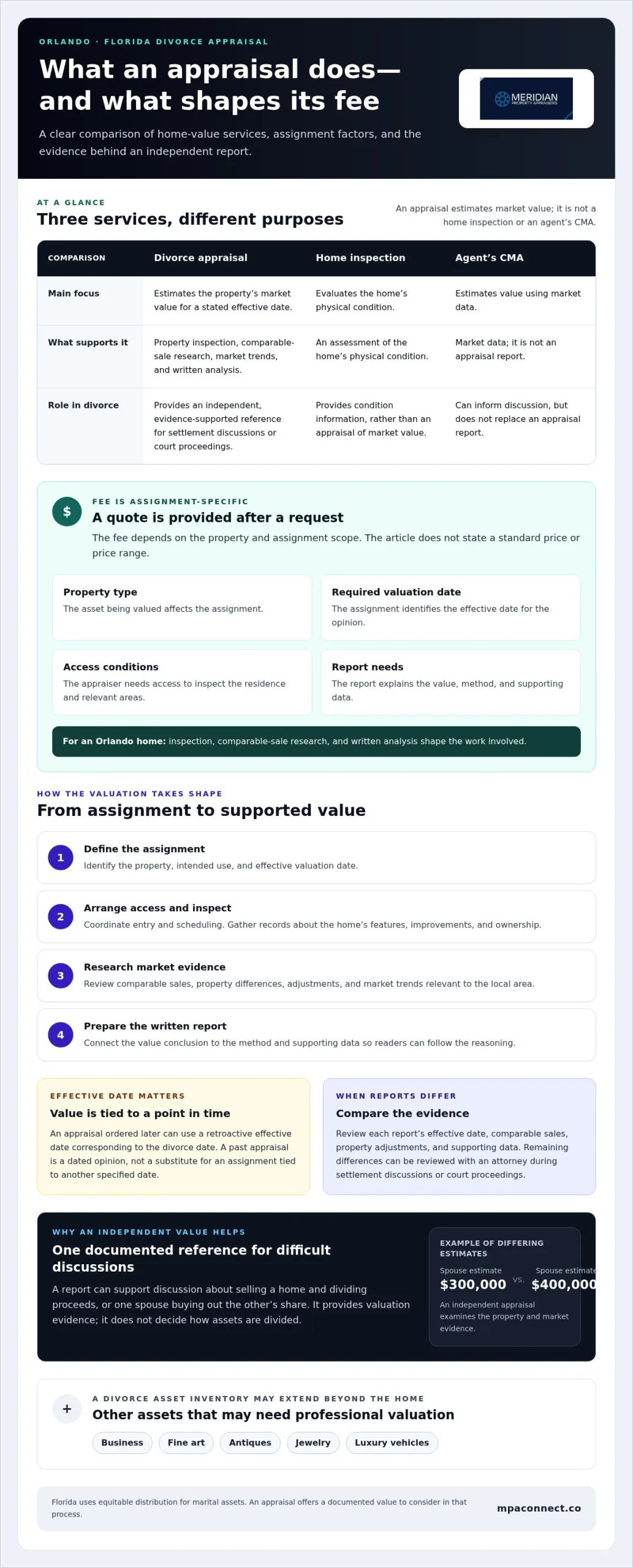
The fee for a Florida divorce appraisal depends on the property and assignment scope, and is provided after a quote request. Factors include property type, required valuation date, access conditions, and report needs. For an Orlando home, the inspection, comparable-sale research, and written analysis shape the work involved. A careful report gives spouses and their attorney a documented value to consider during settlement discussions.
A divorce appraisal estimates market value. A home inspection evaluates physical condition, while a real estate agent’s comparative market analysis, or CMA, estimates value using market data. In Florida, equitable distribution applies to marital assets, and an independent appraisal can help spouses address the home’s value in that process. A CMA can inform discussion, but it is not an appraisal report.
The Florida divorce appraisal process usually follows clear steps: arrange access, inspect the property, research comparable sales and market trends, then prepare a report explaining the value, method, and supporting data. Gather records about the home’s features, improvements, and ownership. The appraiser needs access to inspect the residence and relevant areas, so the designated person can coordinate entry and scheduling.
What valuation date applies to property division in a Florida divorce? The assignment identifies the effective date for the appraiser’s opinion. An appraisal ordered later can use a retroactive effective date corresponding to the divorce date, providing a value tied to that point in time.
What happens if spouses disagree on an Orlando home appraisal? Compare each report’s effective date, comparable sales, property adjustments, and supporting data. If differences remain, the parties can review the competing evidence with their attorney as they work toward settlement or present the dispute in court.
What credentials should a Florida divorce real estate appraiser have? Look for impartiality and courtroom experience as an expert witness. A professionally supported, defensible report should clearly explain its valuation method and evidence.
How are appraisals used to divide or buy out a marital home in Florida? Spouses can use the appraised value to discuss selling the home and dividing the proceeds, or one spouse buying out the other’s share. A precise valuation gives settlement discussions a common reference point.
For a South Florida property, identify its county and the assignment’s geographic scope at the outset. This discussion addresses Orlando, so don’t assume it applies to a South Florida county. The county helps define the local market evidence relevant to the property.
For a home appraisal, provide access and property information, then review how the report connects its conclusion to market evidence. This helps spouses understand what the valuation measures and gives their attorney a clear basis for discussing Florida’s equitable distribution of marital assets.
Independent valuation for matrimonial disputes
An independent appraisal gives spouses a professional opinion of a property’s market value at a specific point in time. It can help when one spouse believes the home is worth more than the other does, or when a buyout depends on a defensible figure. The assignment focuses on value, not on advocating for either party’s preferred settlement. Its purpose is to provide a clear, evidence-supported reference point for negotiations or court proceedings.
Consider a Florida divorce where one spouse estimates the home at $300,000 and the other estimates $400,000. That gap can affect settlement discussions, especially if one spouse hopes to keep the residence. An appraisal examines the property and relevant market evidence to develop an independent value. The report can then help the spouses and their attorney identify what drives the difference, rather than relying only on competing estimates.
Either spouse or an attorney may submit an appraisal request. The request should identify the property, intended use, and effective valuation date. If the assignment takes place after the relevant date, the appraiser can use a retroactive effective date corresponding to the divorce date. This states the opinion as of the requested date, rather than treating a later inspection date as the valuation date.
The report should explain its conclusion and supporting method so readers can follow the reasoning. If a residence was last appraised five years ago, a new valuation can provide information about its current market context. A past report is a dated opinion, not a substitute for an assessment tied to the present assignment or another specified effective date. Clear dates help distinguish those opinions during a dispute.
Professional support matters if the appraisal may be submitted as evidence. A defensible report connects its value conclusion to the property and supporting data, rather than offering a bare figure. Appraisers are also bound by the confidentiality ethics provision of the Uniform Standards of Professional Appraisal Practice (USPAP). That standard is relevant when spouses share sensitive property or financial information for the assignment.
An independent valuation can inform either of the common home-settlement paths: selling the residence and dividing the proceeds, or one spouse buying out the other’s share. In a buyout discussion, the appraised value gives the parties a shared basis for considering the home’s worth. The appraisal does not decide how assets are divided; it provides valuation evidence for the broader settlement process.
Keep the assignment focused. State the valuation purpose and date, arrange property access, and preserve the completed report with its supporting analysis. If a separate tax-related valuation is also needed, a tax valuation appraisal addresses that distinct purpose.
Real estate and other assets requiring appraisal
A divorce asset inventory can include more than the Orlando residence. Florida divorce matters may involve real estate, businesses, fine art, antiques, jewelry, and luxury vehicles. Each is a different kind of property, so start by listing the assets and identifying which values are disputed. A home appraisal can establish fair market value for real estate, while a broader inventory helps spouses see what else may affect settlement discussions.
Start with property connected to the marriage or estate being reviewed. A residence, rental property, or vacation home may have a distinct ownership history and use. Record each property’s address, ownership details, and intended valuation date. For personal property, identify the item and gather records that describe it, such as purchase or ownership documents. An organized inventory gives attorneys and accountants a clearer picture of the valuation questions involved.
- Real estate: A primary home, rental property, or other parcel may need a residential valuation.
- Business interests: A business may be an asset requiring its own valuation analysis.
- Collectibles: Fine art and antiques can be listed separately from household contents.
- Personal valuables: Jewelry and luxury vehicles may need attention when their values are disputed.
Are there special appraisal considerations for condos, investment properties, or vacation homes in Orlando? Yes. A condo’s unit features and shared-property context differ from those of a detached home, while an investment property’s income and use matter to its analysis. A vacation home also requires attention to its location, condition, and relevant comparable properties.
For real estate, keep the assignment focused on the specific property and intended use of the opinion. A residential appraisal can address fair market value, while business interests, art, antiques, jewelry, and vehicles are separate asset classes. Listing these items distinctly helps prevent a home valuation from being mistaken for a complete assessment of every marital asset.
Attorneys and accountants use property valuations for estates, divorces, and other disputes involving real property. A clear opinion of value may help them review a settlement or estate inventory. For example, a residence and a separate rental property should appear as separate entries, even if the same spouses own both. Separate descriptions make it easier to track each property and its valuation.
Before requesting a real estate valuation, organize property records and note any disagreement about value or purpose. Then identify which assets require a real estate opinion and which belong to another category. This inventory clarifies the valuation scope and keeps the Orlando home’s analysis distinct from questions about businesses, collectibles, and personal property.
Researching comparable home sales
For an Orlando divorce appraisal, comparable sales connect a home’s features to actual market evidence. The sales comparison approach examines similar properties sold in the same market, then accounts for meaningful differences. The goal isn’t to find an identical house, but to understand how buyers and sellers valued properties with relevant similarities.
The appraiser begins by identifying the subject property’s characteristics. Location, property type, size, layout, condition, and notable features help determine which sales are useful. A nearby sale may be a poor comparison if it involves a different property type or substantially different condition. A sale farther away may provide better evidence if it reflects a more similar market and property.
After selecting potential comparables, the appraiser reviews each sale and considers its differences from the subject. For example, if a comparable home has a feature the subject lacks, the analysis accounts for that difference. The same principle applies to condition, size, and other characteristics that affect how the properties compare. Adjustments help interpret each sale in relation to the home being appraised.
- Define the subject: Record its location, property type, size, condition, and relevant features.
- Identify comparable sales: Focus on properties sold in the same market with meaningful similarities.
- Analyze differences: Explain how each comparable differs and how those differences affect the comparison.
- Reconcile the evidence: Weigh the most relevant sales to form a supported value opinion.
Selecting comparable sales requires judgment, not just searching for the closest address. A sale in a similar location but with a different property type may be less informative than a more comparable home elsewhere in the same market. The report should explain why the selected sales indicate value and how their differences were considered.
A comparative market analysis can estimate fair market value by comparing a home with recently sold nearby properties. An appraisal adds a documented valuation analysis, including the appraiser’s method and supporting data. When parties review different estimates, the underlying sales and adjustments can clarify whether the disagreement concerns property facts, selected evidence, or how that evidence was interpreted.
When reading the appraisal, look for a clear connection between the subject home and each comparable sale. Check that the report identifies relevant differences and explains its reasoning. If a sale seems dissimilar, note the specific feature that concerns you and discuss it with your attorney. Focused questions about evidence are more useful than comparing headline values alone.
Comparable sales are one part of the Florida appraisal process, alongside property inspection and market-trend research. Together, these elements support a reasoned opinion of value. For spouses deciding whether to sell an Orlando home or consider a buyout, understanding the comparable-sales analysis makes the report’s conclusion easier to evaluate.
How do I find a qualified divorce appraiser in Orlando?
Choose an appraiser whose work fits the assignment, not simply someone who estimates home prices. For an Orlando divorce, impartiality matters because the valuation may inform negotiations between spouses or become evidence in court. Courtroom experience as an expert witness is also relevant. These qualities support a report that explains its reasoning and can withstand close review.
Begin by defining the assignment. Identify the property, purpose of the appraisal, and effective valuation date. A current market opinion and a retrospective opinion address different dates, so specify the requested date. If an attorney is coordinating the request, align the assignment details with the divorce matter’s needs before arranging access.
Next, assess how the appraiser will document the analysis. A useful report identifies its valuation method, comparable sales, adjustments, and supporting data. It should explain why the selected market evidence relates to the home, rather than present only a final value. If two reports reach different conclusions, for example, the parties can compare their effective dates, comparable properties, and reasoning.
Ask about the appraiser’s experience giving court testimony. The key point is not simply whether the person has prepared reports. Courtroom experience as an expert witness can help an appraiser explain methods and conclusions clearly under scrutiny. Impartiality remains essential: the appraiser develops an independent opinion, not an argument for either spouse’s preferred outcome.
Review the assignment’s communication and access arrangements. Identify who will coordinate entry, provide property details, and receive the report. A designated contact can help schedule the inspection and reduce confusion between the parties. Share relevant records and explain the intended use so the appraiser can frame the assignment appropriately.
Confidentiality also matters in a divorce. Appraisers are bound by the confidentiality ethics provision of the Uniform Standards of Professional Appraisal Practice (USPAP). Ask how the report and information provided for the assignment will be handled. Keep communication focused on property facts, assignment scope, and the effective date, rather than requests for a preferred conclusion.
Before proceeding, compare the proposed scope with the questions the valuation must answer. Confirm that the report will address the correct property and date, with supporting evidence. This practical review helps an attorney and the parties understand what the appraisal can contribute to settlement discussions or court evidence.
If you’re ready to discuss an impartial valuation for a divorce matter, request an appraisal consultation.
Meridian Property Appraisers Inc.: Pre-Probate Inherited Properties Appraisal
Meridian Property Appraisers Inc. provides divorce appraisals when spouses need an independent residential valuation for settlement discussions. The appraisal can help clarify a home’s value when spouses disagree or are considering a buyout. For inherited real estate connected to an estate, its Pre-Probate Inherited Properties Appraisal addresses a different valuation need. The right assignment depends on the property and purpose of the report.
For a divorce-related valuation, prepare the property address, intended valuation date, and access arrangements. These details help define the assignment and keep the report focused on the question at hand. Contact Meridian Property Appraisers Inc. to discuss a Divorce Appraisal, or visit mpaconnect.co.
Choose a Clear Next Step
Before making a settlement decision, consider what the valuation needs to support: a home buyout, a possible sale, or a broader property discussion. A divorce property appraisal in Orlando can give the parties a professional reference point for that conversation. Meridian Property Appraisers Inc. offers divorce appraisals for divorce-related valuation needs, pre-listing appraisals when preparing a property for sale, and pre-probate inherited property appraisals for inherited real estate before probate.
To move forward, gather the property address, relevant timing, and any details that clarify the assignment’s purpose. That preparation helps frame the valuation request around the decision ahead, rather than leaving the scope unclear. For an independent appraisal to support your next step, contact Meridian Property Appraisers Inc. A measured, well-defined start can make a difficult property decision easier to approach.
Frequently Asked Questions
Finalizing a Divorce Involves Many Decisions. Who Keeps the House?
Spouses may agree that one keeps the home, or they may sell it and divide the proceeds. Florida’s equitable distribution applies to marital assets, so the residence is considered within the broader property settlement. If one spouse wants to remain, a buyout may be discussed using an agreed value as a starting point. The settlement also needs to account for the home alongside the couple’s other assets.
When Is an Appraisal Needed?
An appraisal is useful when spouses can’t agree on a property’s value or need a sound basis for discussing a buyout. It can also provide an opinion tied to a particular date, such as a past date relevant to the divorce. If one spouse plans to keep a jointly owned home, for example, a documented valuation can give both parties a more informed starting point for negotiations.
What Does a Divorce Property Appraisal Cost in Orlando, Florida?
The fee depends on the assignment and is provided after a quote request. Factors include property type, access, valuation date, and report requirements. For a divorce property appraisal in Orlando, clarify whether the assignment concerns current value or a specific past date, since that affects the requested analysis. Sharing the property address and purpose helps define the work needed for a quote.
How Is a Marital Home Valued for Divorce in Florida?
An appraiser develops an opinion of market value by inspecting the home and analyzing relevant property and market information. The analysis considers the home’s location, size, layout, and condition alongside comparable sales. The report explains the valuation method and evidence supporting its conclusion. Ensure the assignment identifies the effective date, because the opinion applies to that date, not every stage of the divorce.
Can Divorcing Spouses Use One Appraiser, or Should Each Hire Their Own?
Spouses can use one independent appraiser if they agree on the assignment’s purpose, effective date, and access arrangements. A shared report gives both parties the same valuation evidence to review. If they disagree on the result or assignment terms, each may obtain a separate opinion. Compare the reports’ dates, comparable sales, and reasoning, rather than focusing only on different final values.
How Long Does a Divorce Home Appraisal Take in Orlando?
The appraisal involves scheduling access, inspecting the property, researching market evidence, and preparing the report. Timing depends on access coordination, property complexity, and the scope of analysis. The relevant market is local: an Orlando property should be analyzed in its market context, just as a home in Tampa, Saint Petersburg, Jacksonville, Clearwater, Largo, Pinellas Park, Seminole, Miami, or Fort Lauderdale requires location-specific evidence.


